Fermentation is usually the most forgiving part of the distilling process, but that does not mean it always goes smoothly. A wash that is not doing anything visible after 48 hours is stressful, and it is hard to know whether you have a real problem or whether everything is fine and you just cannot see the activity.
The good news is that most fermentation problems have straightforward causes and practical fixes. This guide works through the six questions distillers ask most often, with honest answers based on what is actually happening inside your fermentation vessel.
Why Is My Fermentation Not Bubbling?
This is the question that starts most fermentation panics, and the answer is almost never what people expect. The airlock bubbling is a secondary indicator of fermentation activity, not the primary one. CO2 will take the path of least resistance out of your vessel, and if there is any gap in the lid, grommet, or seal, you will get little or no airlock activity even during vigorous fermentation.
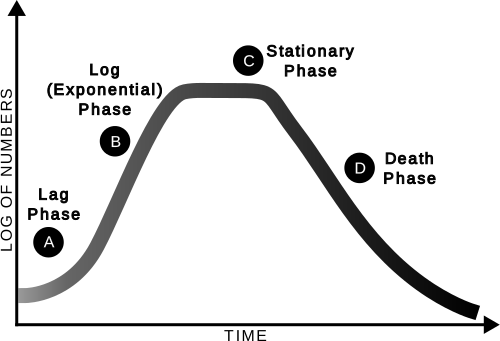
Before concluding that fermentation has not started, work through this list:
- 1Check the vessel seal. Press down firmly on the lid and watch the airlock. If bubbles appear, you have found your leak. Re-seat the lid and grommet and try a thin smear of petroleum jelly around the grommet edge to improve the seal.
- 2Check the water level in the airlock. An S-bend airlock needs water or sanitiser solution to bubble. If it has dried out, CO2 has been venting silently and fermentation may be progressing normally.
- 3Take a gravity reading. If the gravity has dropped from your original gravity, fermentation is working. If it matches your original gravity exactly, it has not started yet.
- 4Check the temperature. Most common distilling yeasts need at least 18°C to ferment reliably. Below that, yeast activity slows dramatically.
- 5Check how long it has been. Many washes take 12 to 36 hours to show visible activity after pitching. If you are checking at the 8-hour mark, wait another day before worrying.
Is My Mash Infected?
This one causes a lot of unnecessary anxiety. The short answer is: probably not, and even if it is mildly contaminated, it may not matter after distillation. Here is how to tell the difference between normal fermentation activity and a genuine infection.
The most common surface growth that alarms distillers is a thin white pellicle formed by wild yeast or lactobacillus bacteria. It looks worrying but in most cases the wash underneath smells fine and is fermenting normally. Since you are distilling rather than drinking it directly, mild contamination rarely affects the final spirit.
Visible mould with colour (anything other than white) is a different matter. That wash should be discarded rather than distilled. The same applies to anything with a genuinely foul or putrid smell.
Why Did My Fermentation Stop Early?
A fermentation that stops before your wash reaches its expected final gravity is called a stuck fermentation. The gravity plateaus and stops dropping even though the wash still tastes sweet. The most common causes are:
Nutrient deficiency is one of the most common causes of stuck fermentation. Learn how to add the right nutrients at the right time.
- Temperature dropped below the yeast minimum. If ambient temperature fell overnight, your yeast may have gone dormant without finishing the job. This is the most common cause of stuck fermentations in seasonal climates.
- Nutrient deficiency. Sugar washes are notorious for stressing yeast because pure sucrose provides no nitrogen, minerals, or vitamins. Yeast health declines partway through fermentation and activity stops before completion.
- Too high an original gravity. Starting above 1.110 SG or roughly 28% sugar by weight creates a high-osmotic environment that stresses yeast immediately.
- Alcohol tolerance exceeded. Every yeast strain has a maximum alcohol tolerance. Standard bread yeast may stop at 8 to 10% ABV. Distilling or wine yeasts typically handle 14 to 18%.
Enter your original gravity and current gravity into the Fermentation ABV Calculator to see the actual ABV and confirm whether your fermentation is stuck or simply finished.
Can Fermentation Restart After It Has Stopped?
Yes, in most cases. A stuck fermentation can often be restarted and it is worth trying before discarding a batch.
- 1Confirm it is actually stuck. Take gravity readings 48 hours apart. If there is no movement at all, it is stuck. Even a tiny drop means it is still working slowly.
- 2Raise the temperature. Move the fermenter somewhere warmer. The top of the recommended temperature range for your yeast is often enough to rouse dormant cells back into activity.
- 3Gently rouse the yeast. Give the fermenter a slow, gentle swirl to disturb the yeast sediment on the bottom and get it back into suspension. Do not shake vigorously as this introduces oxygen at the wrong stage.
- 4Add yeast nutrients. A pinch of DAP or a commercial blend like Fermaid-K can give stressed yeast enough of what they need to push through to completion. The Yeast Nutrient Calculator can help with the right dose.
- 5Pitch a fresh active starter. If the above steps do not move gravity within 48 hours, make a small starter with a fresh sachet of yeast in warm water with a pinch of sugar, let it activate for 30 minutes, then pitch it into the stuck wash.
Why Is My Airlock Not Bubbling?
An airlock that is not bubbling is not automatically a problem. Here are the four most likely reasons:
Never rely on the airlock as your only indicator of fermentation progress. A hydrometer reading is the only way to know with certainty what is happening inside the vessel.
Is Foam Normal After Pitching Yeast?
Yes, completely. The thick foam that appears anywhere from 12 to 48 hours after pitching is called Krausen and it is one of the best signs you can see. It means your yeast is healthy, well-fed, and actively reproducing and fermenting.
Krausen forms because CO2 produced by fermentation rises through the liquid and carries proteins and yeast cells to the surface, creating a stable foam layer. It typically peaks somewhere between 24 and 72 hours after pitching and then gradually falls back on its own as fermentation moves into the conditioning phase.
You do not need to do anything about Krausen. Do not skim it off, do not stir it back in. Leave it alone and it will subside naturally. The only practical concern is overflow: if you have a very active fermentation in a vessel filled close to the top, Krausen can push through the airlock. Leave around 20% headspace when filling to avoid this.
How Do I Know When Fermentation Is Finished?
Fermentation is complete when the gravity has reached the expected final gravity and holds stable across two readings taken 24 to 48 hours apart. A single low reading is not enough because a slow-moving fermentation can look finished but still have a little further to go.
The expected final gravity for a sugar wash with a healthy distilling yeast is typically between 0.990 and 1.000 SG. For grain mashes, expect between 1.005 and 1.015 SG depending on the mash composition and yeast strain. If your gravity has been sitting at the same number for two consecutive days and the wash smells clean, you are ready to move on to the still.
Frequently Asked Questions
Prevention is better than troubleshooting. The Brewer and Distiller's Handbook covers fermentation science, yeast health, and the complete brewing and distilling process so you understand why problems occur.
Take the numbers to the still.
Five essential calculators as an offline app, plus the printable quick-reference PDF. New guides and calculators when they launch. No spam.
Unsubscribe any time. By subscribing you agree to the Privacy Policy.
References
Primary and peer-reviewed sources for the technical claims on this page.
- The Australian Wine Research Institute (AWRI). Yeast Assimilable Nitrogen (YAN). Cited for: Minimum YAN for low-risk fermentation and the way nitrogen requirement scales with starting sugar, yeast strain and fermentation temperature.
- Gerling, C., Enology Extension Associate, Cornell University NYSAES, Veraison to Harvest No. 6 (October 2010). FAQs about Yeast Assimilable Nitrogen. Cited for: An independent statement of the 150 mg/L YAN baseline with 200–250 mg/L preferred, that nitrogen demand rises with Brix and temperature stress, and the rationale for staggering nutrient additions rather than dosing once at the start.