New distillers often buy a single hydrometer and assume it will work for everything. It will not. The instrument used to track fermentation measures density on a specific gravity scale and is completely unsuitable for measuring distillate. The instrument used to check distillate reads ABV directly and is useless for monitoring a wash. Understanding which is which, and how to use each correctly, is foundational to accurate distilling.
The Two Instruments Every Distiller Needs
Both instruments work on the same physical principle: a denser liquid pushes a floating glass instrument higher, a less dense liquid lets it sink further. The difference is in what liquid they are designed for and how their scales are calibrated.
Reading a Brewing Hydrometer
The brewing hydrometer floats in your wash and you read the specific gravity (SG) from the numbered scale on the stem. The key technique points are the same as any hydrometer, but worth stating clearly.
How to read the scale
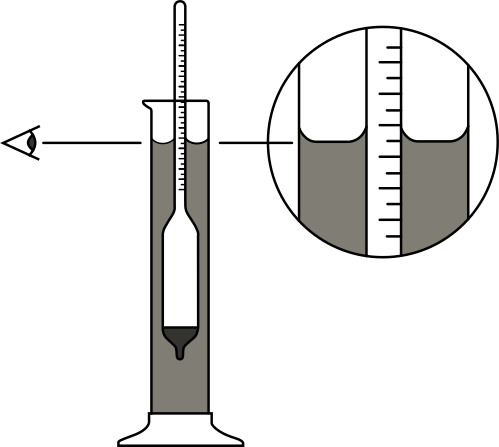
When the hydrometer floats in your sample, the liquid surface curves slightly upward around the stem. This is the meniscus. The correct reading is taken at the bottom of the meniscus, not the top. Reading from the top will give you a reading approximately 0.002 SG higher than the true value, which translates to roughly 0.25% overstating potential ABV.
Always bring your eye to the level of the liquid surface before reading. Viewing from above or below introduces parallax error in the same direction as reading the wrong part of the meniscus.
Temperature and brewing hydrometers
Most brewing hydrometers are calibrated at either 15°C (59°F) or 20°C (68°F): check the documentation with yours. Readings taken at other temperatures will be slightly off. For typical fermentation monitoring where you are tracking the direction of change rather than a precise absolute, a small temperature error is usually acceptable. For precise OG readings at the start, bring the sample to the calibration temperature or apply the correction from your instrument's chart.
A triple-scale brewing hydrometer. Triple-scale models show specific gravity, potential ABV, and Brix on a single instrument, more useful than SG-only models for distilling purposes. Look for one rated to at least 1.130 SG to cover high-gravity washes.
Calculating Wash ABV from OG and FG
The primary purpose of the brewing hydrometer in distilling is to calculate the alcohol content of your wash, which tells you how much spirit to expect from a run. You take two readings: one at the start of fermentation (Original Gravity, OG) and one at the end (Final Gravity, FG).
ABV ≈ (1.080 − 1.002) × 131.25 = 0.078 × 131.25 ≈ 10.2% ABV
This formula is a reliable approximation for the ABV ranges typical in distilling washes (roughly 5–15% ABV). It becomes less accurate above 15% ABV because the relationship between SG drop and alcohol content is not perfectly linear at higher strengths.
Some common reference points for wash gravities:
| Wash Type | Typical OG | Typical FG | Est. ABV |
|---|---|---|---|
| Light sugar wash | 1.050–1.060 | 0.998–1.002 | 6–8% |
| Standard sugar wash | 1.070–1.090 | 0.998–1.003 | 9–12% |
| High-gravity sugar wash | 1.100–1.120 | 1.000–1.005 | 13–16% |
| Grain mash (beer-style) | 1.050–1.075 | 1.008–1.015 | 5–8% |
| Fruit wash / cider | 1.045–1.080 | 0.998–1.005 | 6–10% |
Enter your OG and current gravity to track ABV progress, estimated alcohol yield, and whether fermentation is complete.
Reading a Spirit Hydrometer (Alcoholmeter)
The alcoholmeter works on exactly the same physical principle as the brewing hydrometer but is calibrated for ethanol-water mixtures at distillate strengths. The scale reads directly in % ABV rather than specific gravity.
The technique is the same: read from the bottom of the meniscus
Lower the alcoholmeter gently into your sample and let it settle. The liquid will curve upward around the stem. Read the ABV at the bottom of that curve, at eye level. Reading from the top adds roughly 0.5–1% ABV to the true reading.
Temperature is critical at distillate strengths
Alcoholmeters are calibrated at 20°C. At distillate working strengths, typically 60–80% ABV during a spirit run, a 5°C deviation from 20°C can shift your reading by 1.5–2.5% ABV. This is a meaningful error, particularly if you are using the reading to calculate a water addition for dilution.
The best approach is to bring your sample to 20°C before reading. If that is not practical, note the actual temperature and apply a correction using the Proof Converter or the correction table in our temperature correction guide.
A glass alcoholmeter rated 0–100% ABV, calibrated at 20°C. This is the instrument you use to measure your distillate, not a brewing hydrometer. Look for a glass model rather than plastic; glass gives a more accurate reading and is easier to clean between uses.
Step-by-Step: Taking a Brewing Hydrometer Reading
- 1 Draw a sample into a measuring cylinder. Use a wine thief, turkey baster, or sample tube to transfer enough wash into a clean cylinder for the hydrometer to float freely. Never put the hydrometer directly in the fermenter. You risk contamination and breakage.
- 2 Bring to the calibration temperature if precision matters. For your OG reading (which anchors all subsequent calculations), take the time to bring the sample to your hydrometer's calibration temperature. A thermometer tells you where you are.
- 3 Lower the hydrometer gently and spin it. Drop it in slowly and give it a slight spin to dislodge any air bubbles clinging to the stem. Bubbles raise the hydrometer and give a false-low gravity reading.
- 4 Read at eye level from the bottom of the meniscus. Let the hydrometer settle completely, bring your eye to liquid level, and read the scale at the bottom of the liquid curve around the stem.
- 5 Record the reading. Write down both the gravity and the date. For OG, note the temperature too. Tracking gravity over time shows fermentation progress and tells you when the wash is ready to run.
Step-by-Step: Taking an Alcoholmeter Reading
- 1 Fill a clean, dry measuring cylinder. Rinse with a small amount of the spirit you are about to measure, then fill to working depth. Using a contaminated or wet cylinder dilutes your sample and gives a false-low ABV.
- 2 Bring the sample to 20°C. Place the cylinder in a water bath at 20°C for 10 minutes. Check the temperature before proceeding. If you cannot reach 20°C exactly, note the actual temperature for correction in step 5.
- 3 Lower the alcoholmeter gently and spin it. As with the brewing hydrometer, a slow spin on release removes air bubbles that would make the instrument float high.
- 4 Read at eye level from the bottom of the meniscus. Let the instrument fully settle before reading. The ABV is the scale value at the lowest point of the liquid curve around the stem.
- 5 Apply temperature correction if your sample was not at 20°C. Use the Proof Converter to get the corrected ABV at 20°C. This corrected value is what you use for all dilution or blending calculations.
Common Mistakes to Avoid
- Using a brewing hydrometer on distillate. The most common error. At distillate strengths, a brewing hydrometer gives a meaningless reading. Always use an alcoholmeter for distillate.
- Reading from the top of the meniscus. Both instruments require reading from the bottom of the liquid curve. Reading from the top overstates specific gravity on a brewing hydrometer and overstates ABV on an alcoholmeter.
- Not spinning the hydrometer on release. Air bubbles clinging to the stem push the instrument higher than it should float, giving a false reading in both instruments.
- Putting the hydrometer directly in the fermenter. Take a sample into a separate cylinder every time. Direct measurement risks breaking the instrument, contaminating your wash, and gives a less accurate reading due to turbulence and CO₂ activity.
- Ignoring temperature on the alcoholmeter. Even a few degrees off 20°C introduces meaningful error at distillate strengths. Always verify temperature and apply a correction if needed.
- Not taking an OG reading. Without OG, you cannot calculate wash ABV, and without wash ABV you cannot estimate your expected spirit yield. Take OG before pitching yeast, every time.
Enter your measured ABV and sample temperature to get the corrected true ABV at 20°C.
Frequently Asked Questions
Master the numbers. The Brewer and Distiller's Handbook covers measurement, fermentation science, and the complete brewing and distilling process. Essential reading once you have the basics down.
Take the numbers to the still.
Five essential calculators as an offline app, plus the printable quick-reference PDF. New guides and calculators when they launch. No spam.
Unsubscribe any time. By subscribing you agree to the Privacy Policy.